For this proof I did this:
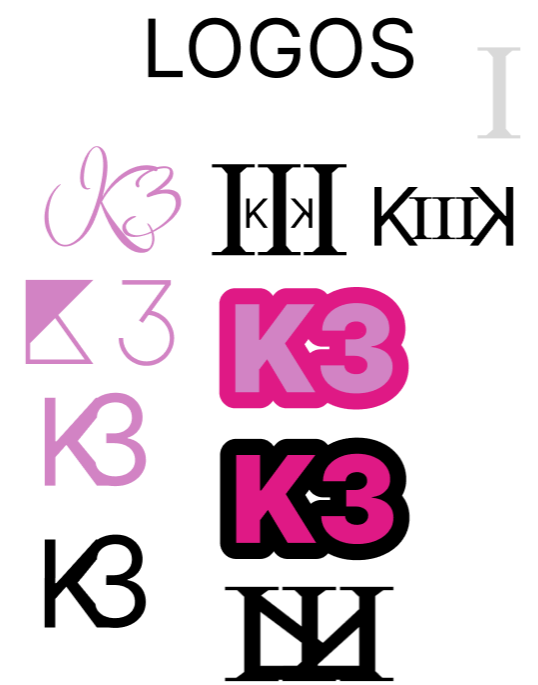
For this proof, I worked on creating some logo concepts for our group project. We were building a brand identity for our fictional studio, and I took inspiration from the Belgian girl group K3, which influenced the playful direction we were initially going for.
I focused on making text-based logos, mainly using the letter K or the number 3 as a base. I tried out different fonts and combinations, and even looked into Roman numerals to give the designs a more unique feel. To get more ideas, I also searched online for logo inspiration from pop culture and creative brands.
In the end, we didn’t go with my designs — the group chose someone else’s version — but I still really enjoyed the creative process. It was a fun way to explore design, and it gave me some solid practice with branding. Even if it wasn’t used, it’s still good proof of my contribution to the project.
https://www.figma.com/design/zFzy7120Fu5suQJLlsGnJf/Studio-Logos?node-id=0-1&t=Y85nUl3wXPedlJ9N-1
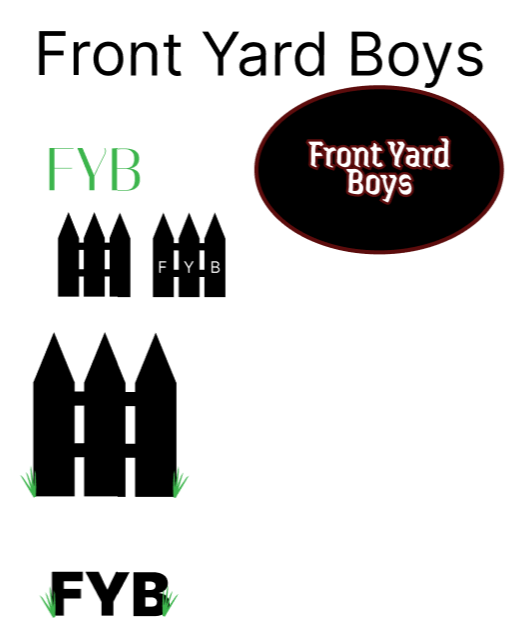
After getting some feedback, we were advised not to fully base our studio on K3 — mainly because of copyright concerns and the overall tone not being serious enough. So, we decided to rebrand to something more original (and still a bit fun): The Frontyard Boys, a playful parody of The Backstreet Boys.
I created a new set of logo designs, which you can check out in the link below. This time, I tried to come up with something that actually fit the new name. I imagined a front yard and added things like a fence and some grass, since that’s what came to mind when thinking about the word "yard."
I struggled a bit with finding strong inspiration for this version — it was harder to think of something that felt really unique. But even so, it was good practice, and it helped me stay involved in the visual side of our brand. In the end, it added to the creative process and gave me another chance to build design skills.
https://www.figma.com/design/zFzy7120Fu5suQJLlsGnJf/Studio-Logos?node-id=0-1&t=Y85nUl3wXPedlJ9N-1
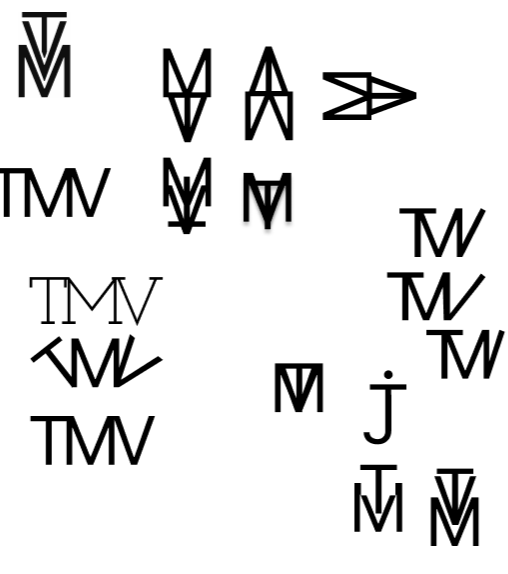
For my portfolio, I started working on some personal logo designs to give myself and my website a bit of visual identity. I wanted to use my initials TMV, but honestly, I found it tricky to come up with something that felt right or original at first.
I started designing in Figma because it’s a tool I’m more familiar with, but then I switched to Adobe Illustrator since I wanted to challenge myself and learn how it works. In the end, I managed to create one original logo and added it to my collection of other ideas in my Figma document.
I haven’t fully decided on one logo yet, and I feel like I’m still in the middle of the process. I want to keep experimenting and improving. I also got the advice to choose two or three strong logos and then make a few variations of each, which I plan to do as my next step. It's a work in progress, but I'm enjoying the creative process and learning as I go.
https://www.figma.com/design/HCQKkvDwA22GNB7ioTTPn5/Logo-portfolio?node-id=0-1&t=GV0qge8O23IVaCMz-1
For this proof I did this:
After our poster presentation, we decided to refresh the webapp’s branding. Our previous pink and blue color scheme felt a bit too playful, so we wanted a more professional look that would help the project be taken seriously. The new branding definitely has a stronger impact and looks much cleaner.
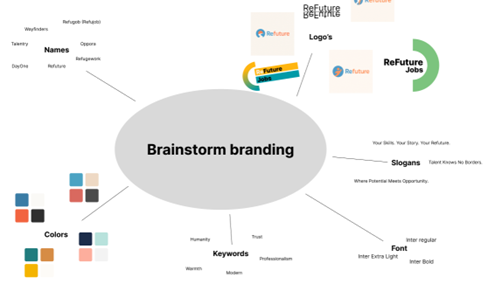
I took the lead on brainstorming ideas and created a basic brand guide for the project. Since we also settled on a new name, “Refuture”, which combines “refugee” and “future,” I designed several new logo concepts to reflect this fresh direction. The aim of the project is to assist refugees in finding employment and building a better future here in the Netherlands.
During the brainstorming, I focused on essential brand elements like color palettes, typography, and logo variations. Coming up with a suitable name was tricky, so I generated several AI-based suggestions. I also drafted some potential slogans and identified key themes that capture our work approach and the website’s visual style.
https://www.figma.com/design/HCQKkvDwA22GNB7ioTTPn5/Logo-portfolio?node-id=0-1&t=GV0qge8O23IVaCMz-1
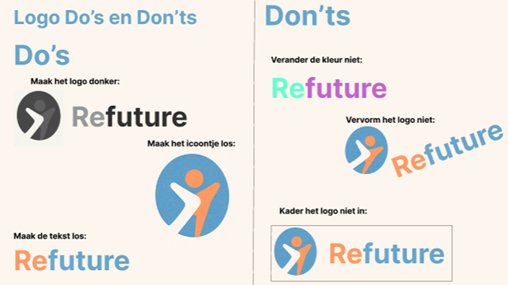
As part of refining our brand identity, I developed a set of logo do’s and don’ts to make sure our new branding would be used consistently across all materials. At first, I wasn’t completely sure what to include, so I did some research and looked at different branding guides online to get a feel for best practices. That really helped me figure out what was important, and from there I put together a set of clear, practical guidelines specifically tailored to the Refuture logo.
Alongside the logo rules, I also expanded our brand guide to include fonts, color schemes, and different logo versions. These details helped bring everything together into a more professional and polished identity. Coming up with the actual name of the project was a bit of a challenge — we wanted something meaningful but still modern and catchy. I experimented with a few AI-generated name ideas, which helped spark inspiration. Eventually, we landed on “Refuture”, combining “refugee” and “future,” which we felt captured both the mission and tone of our platform really well.
I also came up with a few slogans and selected keywords that reflected our goals — helping refugees integrate, find jobs, and build a future — while still keeping the design friendly and approachable.
Looking back, working on the brand guide taught me a lot about how much thought goes into even the smallest visual details. It also showed me the importance of consistency when building a brand. I’m glad I took the time to research and explore different ideas, because it really helped shape a clear and meaningful identity for our project.
For my research and inspiration on brand guides, I referenced this resource: https://www.manypixels.co/blog/brand-design/brand-guides
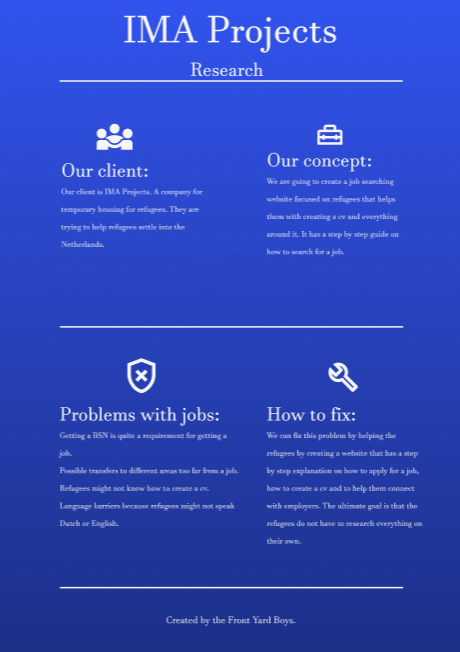
For the poster presentation, every member of our group designed their own version, and we planned to vote on which one we’d use in the end. I created a poster using our Frontyard Boys branding and tried to keep the design simple and clean. My goal was to make the main concept of our project stand out clearly. I thought that by keeping it minimal, it would be easier for people to quickly read and understand the information, especially in a busy setting like a presentation market.
I focused on layout, whitespace, and clarity — thinking less would be more. However, after getting some verbal feedback (unfortunately no Feedpulse), I found out there were quite a few things people would have changed. The main comments were that my poster had too much whitespace and not enough content to fully explain the idea. I was actually ready to revise it right away and make improvements, but my group told me that another team member’s poster was already considered “perfect” by our teachers — so we went with that one instead.
Even though my version wasn’t chosen, I still learned a lot from making it. It taught me that designing for communication is different from just making something look nice — you have to find the right balance between clarity, content, and visual appeal. I also realized how useful feedback can be, and how important it is to test designs with others early on. I’m still considering iterating on the poster just for myself, as practice, since I think it would be helpful to apply the feedback and see how much I can improve it.
https://www.figma.com/design/dxlmuW546uZitjnGPL2AoL/Poster-presentation?node-id=0-1&t=eIXPoFN0VTh2oUDR-1